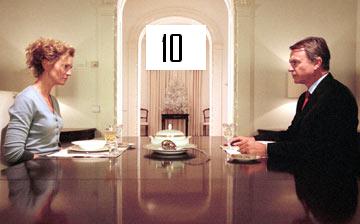
 Sally Potter's Yes (#10) is a glorious mish-mash mess of poetry, music and language, hypnotizingly sexy and soulful. Known primarily as the film composed in iambic pentameter, it is much more than a gimmicky exercise in writing (although the rhythms of Potter's words and the actors' delivery of them is a feat in itself). It is foremostly an examination of transculturation in the present-day world (read: "culture clash" is a term that I find distasteful). Potter argues that no one way of life can today exist in isolation, but must necessarily mutate and take on elements of other cultures to have any chance of growth. Joan Allen and Simon Abkarian, cast as "She" and "He", play lovers who originate from totally dissimiar backgrounds (she an upper-class white biologist, he a Lebanese immigrant working as a chef in a restaurant kitchen). Their affair, once propelled by lust and mutual fascination with one another, eventually sours once suspicions are formed on both sides. Shirley Henderson and Sam Neill also participate in the ensemble, as an expressive houseworker and the cold distant husband respectively. A commentary on divisions made along racial and national lines, Potter examines the issues of representation, globalization and identity in the current modern world. The film is also a study of womanhood, and Potter also carefully raises questions about body image, abortion rights and sexual politics. Lest one think the film is a polemic, it is worth mentioning that these ideas are merely hinted at, rather than explicitly stated. The screenplay manages to evoke a style of speech that may seem foreign initially, but ultimately conveys concepts that are very much a part of the rhetoric and worldview we are familiar with today. Having watching this and Potter's Orlando in close succession, I am excited to seek out the rest of this director's work.
Wednesday, April 05, 2006
#10 (Film in Review 2005)
Sally Potter's Yes (#10) is a glorious mish-mash mess of poetry, music and language, hypnotizingly sexy and soulful. Known primarily as the film composed in iambic pentameter, it is much more than a gimmicky exercise in writing (although the rhythms of Potter's words and the actors' delivery of them is a feat in itself). It is foremostly an examination of transculturation in the present-day world (read: "culture clash" is a term that I find distasteful). Potter argues that no one way of life can today exist in isolation, but must necessarily mutate and take on elements of other cultures to have any chance of growth. Joan Allen and Simon Abkarian, cast as "She" and "He", play lovers who originate from totally dissimiar backgrounds (she an upper-class white biologist, he a Lebanese immigrant working as a chef in a restaurant kitchen). Their affair, once propelled by lust and mutual fascination with one another, eventually sours once suspicions are formed on both sides. Shirley Henderson and Sam Neill also participate in the ensemble, as an expressive houseworker and the cold distant husband respectively. A commentary on divisions made along racial and national lines, Potter examines the issues of representation, globalization and identity in the current modern world. The film is also a study of womanhood, and Potter also carefully raises questions about body image, abortion rights and sexual politics. Lest one think the film is a polemic, it is worth mentioning that these ideas are merely hinted at, rather than explicitly stated. The screenplay manages to evoke a style of speech that may seem foreign initially, but ultimately conveys concepts that are very much a part of the rhetoric and worldview we are familiar with today. Having watching this and Potter's Orlando in close succession, I am excited to seek out the rest of this director's work.

Tuesday, April 04, 2006
#11 (Film in Review 2005)
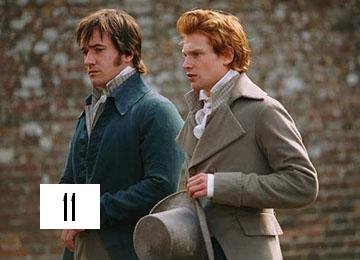 For me, Joe Wright's Pride and Prejudice (#11) was the biggest surprise of the year, a film that far, far surpassed my modest expectations. One could argue that even a shoddy adaptation of a Jane Austen novel would be watchable (the source material is that good), yet a film that attempts to fit her best work into about two hours - and when a prior effort has, in my opinion, already achieved perfection - has a great uphill challenge ahead of it (to say the least). Happily, Wright and his team somehow pulled off the impossible, being original and concise without undermining the source material, or repeating the past efforts of other films. Deborah Moggach's screenplay (with help from Emma Thompson, herself no stranger to Austen adaptations) is something of a small miracle, touching on all the beloved moments in the novel without resorting to hurried "Coles Notes" tactics. In every aspect, the film is a winner, from its outstanding esemble cast (with the exception of the horrid Rupert Friend as Mr. Wickham) to the rich musical score by Dario Marianelli to the dazzling choreography of Wright's camera. It is undoubtedly the best-looking film of the year as well, its costumes, sets and cinematography rivaled only by the gorgeous production values on Wong Kar-Wai's 2046. Even Keira Knightley, who has been painful to watch on-screen otherwise, gives what will probably be the best performance of her career (prove me wrong, Keira! I like being surprised). Perhaps the highest kudos of praise I can give to this film is that it gave me new insight into and appreciation of a text I thought I knew inside-out; that it was able to take a story so well-known (and over-done) and make it seem seemingly untouched.
Link to original capsule Review
#12 (Film in Review 2005)
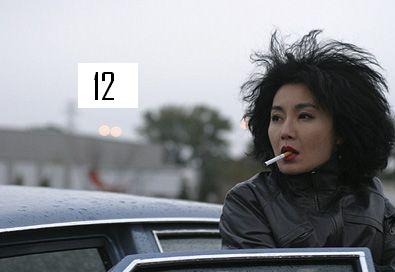 In Olivier Assayas's Clean (#12), Maggie Cheung (pictured, of Hero and In the Mood for Love brilliance) plays Emily Wang, a recovering junkie widow who desperately attempts to re-gain control of her life. Her husband is dead of a drug overdose, she is utterly broke, and her estranged son is in the care of his over-protective paternal grandparents. On top of all this, there is always the danger of her relapsing, which threatens to send her plummeting down a black hole of negation. It sounds like the stuff of off-putting melodrama, yet Assayas mutes the emotion, leaving the viewer to feel moved on his or her own terms. Cheung's fantastic, Cannes-prize winning work is similar, refusing to make Emily's journey an outward display of breakdowns. It is a risky performance, because it threatens to taint any sympathy one might have for her character. But Cheung is a smart actor, and we understand that her ferocious anger stems from a deep vulnerability, one that causes her to reject people even before she knows their true intentions. Assayas wrote the part especially for her (they were once married), just as he did with Irma Vep. Equally stellar in a touching performance is Nick Nolte, playing Emily's father-in-law who is torn between wanting to trust her and having his grandson's best interests at heart. I saw the film almost two years ago at the Toronto Film Festival, and it was released quietly in theatres here a couple of months ago. I hear that it is finally releasing in the States this month, although I don't know whether it will be anything more than a tiny, limited release. It is available on video in Canada now, and there are multiple DVD versions floating around the web. Whatever means by which you access it, do give it a try. At the very least, you will be astounded by Cheung's work - it's worth the watch for that.
Monday, April 03, 2006
#13 (Film in Review 2005)
 Gus Van Sant is undoubtedly one of the most exciting directors working today. I look forward to his work as much as any new effort by Cronenberg, von Trier or Nair. I love his polarizing films so much that I feel a little guilty for not making room for his phenomenal Last Days (#13) on my top ten, as it would have placed in a lesser year (both Elephant and Gerry appeared on my 2003 write-up; you know, the one that exists in my head). But this does not take anything away from his efforts here, both an homage to and a deconstruction of Kurt Cobain and his legacy of grunge rock (as touched upon in my review, see link below). The film will likely alienate viewers unable to bond with Michael Pitt's Blake, or Van Sant's distancing techniques. Yet, upon close consideration, these are extremely accessible human emotions and motifs that anyone can understand. The desire to return to nature, the loss of love, and the crippling nature of addiction are all explored here through a hypnotizing of repetitive images and sounds. Not much happens during the running time, but the singular sequences in and of themselves are stellar little vignettes, beautifully composed. Pay close attention to the use of sound in the film, and how effective the silences are. Pitt plays the rock star here (clearly a stand-in for Cobain), who spends much of the running time muttering to himself, either composing a great swansong to mark his end or simply rambling drug-induced non-sensicals (it is left to us to decide). When I say that the film is open and loose, I mean it as a positive attribute. As I see it, the piece is malleable to any interpretation as conceived of by the viewer. Is it a comedy? (I think so). A tragedy? A wash? Watch it for yourself, and then decide.
Link to original capsule Review
#14 (Film in Review 2005)
 Perhaps the greatest compliment I can pay Henry Alex Rubin and Dana Adam Shapiro's Murderball (#14) is that it makes me want to watch a quad rugby game with the film's featured players. If that does not sound particularly commendable, consider that I am a self-proclaimed member of the "athletically challenged". I have spent my entire life resisting others' attempts (usually those of adult males) to get me involved in playing a competitive sport or compulsively watching one. The more they pushed me into doing so (either by concerned prodding - "Why isn't he interested in this?", or merciless taunting and interrogation - "What the hell is wrong with you?"), the further I distanced myself from that world. Although I can actually become involved in a game if I am there in person (I've been to three hockey games in my life, and I must confess they were all highly enjoyable excursions), sports otherwise take up very little of my time. If it seems that I am interested in the sport of murderball for the sole fact that its players move around in wheelchair-slash-tanks (thereby suggesting a fetishizing or twisted voyeurism on my part), this is not the case. What is different about this game is that I know the people in the chairs, I am familiar with their stories. One thing I find off-putting about competitive (especially televised) sports is that the participants are largely de-personalized. More often than not, they become part of a faceless team, mass identified by their nation or municipal region, and some adoption of an object that abstractly represents said area. I am not arguing for a documentary to be made about every professional team, but perhaps you can understand my point here. Murderball is so compelling because it opens up the world outside of the court, seeing these people as diverse individuals as well as players. And this is why my interest in this sport and these teams has been heightened. Utterly unsentimental and therefore utterly compelling, it's quite a knock-out.
Link to original capsule Review
Note: I apologize for the delay in posting these (it's uni crunch time for me right now). The entries will speed up for the next few days.
Thursday, March 30, 2006
#15 (Film in Review 2005)
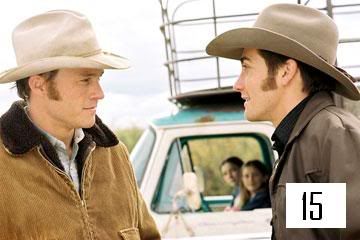 My biggest hope for Ang Lee's Brokeback Mountain (#15 - tie) is for it to be one day considered away from the so-called "controversy" of its subject matter, the backlash of parodies it engendered, and the now-legendary Oscar upset it underwent. Even I must admit that it was extremely difficult to experience the film on its own terms, even back in September at the Toronto Film Festival, because just about everyone had an opinion even when it was in pre-production. To be frank, I think Larry McMurtry, the co-writer of the film, got it right when he suggested, "Perhaps the truth really is, Americans don't want cowboys to be gay". The regression demonstrated on part of the media, the general public and even some of the film's actors was considerably depressing, proving that when we are given a chance to show our readiness to embrace what is different, we choose to remain wilfully ignorant. I was particularly irked by how the film's (subtle, yet present) sexual politics needed to be watered down during the promotion, but I digress from the point at hand... Ulltimately, say what you will, this is a haunting and understated tragedy of lives destroyed by a society characterized by intolerance. I saw the film three times in the theatre, and each time I marvelled at the mastery of Lee's composed observations, as well as the work by the excellent cast of actors (Ledger in particular, is in another class altogether).
Moment of confession: I have a terrible, sometimes alarmingly spotty, memory. Whether it is remembering where I last left my glasses or recalling specific scenes or lines of dialogue from a particular film (even if it is one that I absolutely loved), images and sounds escape my memory within minutes of having encountered them. It is a quality (or failing) I am really quite infur
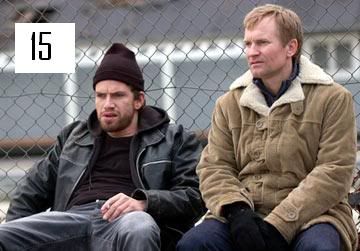 iated by. In regards to film, I have confessed that it takes me at least two viewings to really "get" a film, or imprint it elements of it in my mind. I tend to get so caught up in what is happening, it is difficult for me to be conscious of what I am basically doing (namely being a viewer, watching a movie). It is likely to be the greatest challenge to my efforts in becoming a critic, because that profession requires an individual to work under strict deadlines and form an opinion almost immediately. Yet Susanne Bier's Brothers (#15 - tie) somehow has escaped this fate, and various moments are easily accessible to my mind. Whether it is Johan Soderqvist's lyrical, disorienting score or Connie Nielsen's mysterious facial expressions (What is she thinking?, I wondered throughout), they are all contained within a book in my brain. This is perhaps a telling sign that the film is one that is difficult to shake off after it has said all it has to say. It is a drama that refuses to pander, a tale of adversity that avoids simple moralizing, and ultimately a story that does not enforce a specific feeling upon the viewer.
Link to original Brothers capsule Review
And now, I will change gears for a bit. Fortunately, the number of good to average films I saw this year far outnumbered the few bad ones. But I must give a shout-out to the two especially horrid features that also must be singled out as two of the biggest disappointments of 2005. The first, Martin Campbel
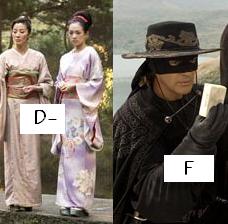 l's The Legend of Zorro, was anything but; an insufferable, pathetic retread of what was absolutely thrilling in its top-ten-worthy predecessor. One of its many transgressions is throwing a plucky young lad into the mix, Zorro and Elena's son, who has somehow inherited all of his father's fighting skills (and none of his wit). Add to this a humourless villain, an end piece lifted from Wild Wild West or any action film involving a train, and sloppy visual effects: the result is a thoroughly painful exercise in blockbuster filmmaking. The other dishonorable mention is Rob Marshall's crippled Memoirs of a Geisha, a film that had tremendous potential and yet managed to offend on every possible count. A exoticized epic that engages in the worst kind of dress-up cinema, Geisha holds no thematic substance, or any attempt at arguing a politics (and if it does, it is considerably problematic, namely that the best an exploited geisha can hope for is a benevolent husband). What's more, stiff acting, tired voiceovers and hideous aesthetics only exacerbate a lame reading of geisha culture as survival of the bitchiest.
Link to original Memoirs capsule Review
Wednesday, March 29, 2006
Introductory Thoughts (Film in Review 2005)
 I think it was back in early January that I had pubicly expressed my disappointment in 2005 as a whole, beating to death the adage that some critics love to espouse at the end of every year. Shame on me for resorting to that silliness. I am reminded of the year 2000, curiously labeled one of the worst years by many reviewers in spite of Dancer in the Dark, Crouching Tiger, The Cell, You Can Count on Me and other masterworks making their mark that same year. The reality is that every year runs the gamut in terms of the movies; you have the masterpieces, and you have the atrocities. No one year can be absolutely termed "bad", "good" or "average". The good art is always there, if you know where to look for it (hint: it will likely not be found at your local multiplex). What I also failed to remember was that there was a wealth of films I had not obtained on DVD before making such a misinformed claim. And indeed, most of my favorite films this year were ones that I had missed out on during their theatrical runs. In that regard, I am glad I did not jump the gun in announcing my top ten before seeing those films, otherwise I'd be tearing out my hair editing and fine-tuning after the fact. Although there are some films I still would have liked to see before compiling this list (such as C.R.A.Z.Y. and Pulse [the original Kurosawa]), I think I'm ready to put 2005 to rest (especially after the exhausting awards season). And what better way to do that than listing the best fifteen (out of 103) films I watched from last year, in ranked order?
At this point, I am ambivalent about sharing my thoughts on the film year overall (such as fascinating trends, big disappointments, etc). I do not think it makes much difference me making the same observations many other critics and box office pundits have made. You know the drill - that Penguin movie (which I did not care to watch) made record-breaking numbers, a divisive film about racism in L.A. won the Best Picture Oscar, and the Star Wars saga finally took a final bow (let us hope). I will say though that it was certainly a busy, exciting calender; we had our usual blockbusters and under-the-radar independents, as well as the politically-charged bunch of productions. But most of all, what surprised me is how quickly it seemed to pass. Perhaps this is just a sensation that comes with growing older, but I can remember watching early birds like The Upside of Anger vividly (even what I ate that day, who I went with, etc). And now, it's a quarter through 2006, and those highly-anticipated titles are just around the corner. It never ends, and the circle continues...
What I am introducing this year as well are The Marigold Petal Awards. The institution's moniker may sound a bit off-putting at first, but I think every prize group has had some trouble with names and standardizing them in the beginning. And yes, I plan to continue them with each passing year. If you have not guessed it already, the title is inspired by the delicate and
 alluring flower featured in Mira Nair's Monsoon Wedding, one of my all-time favourites. The blossom is to me a symbol for life, happiness and love, while the film is a glowing celebration of music and the art of movie-making (all of them what I live for, except perhaps the love part). Once I considered the title, it stuck immediately; it seems the perfect way in which to honour my picks this year (representing organic growth, uniqueness and vibrancy - qualities I look for in a winner). Plus, at least it sounds interesting (like a Film Festival prize), moreso than "The Ali Awards" or something along those lines. The categories remain similar to those established every year by the Academy of Motion Picture Arts and Sciences, although there will be inclusions (such as Best Ensemble Cast) and omissions (such as Best Foreign Film, Animated Feature and Documentary - I have not seen enough to justify competitive races).
I think now is a good time to unveil the ones that just missed the list - the runner-ups. Starting off is Phil Morrison's Junebug, an endearing look at the tensions and changes exerienced by a small family living in North Carolina when a well-meaning newcomer disrupts the usual order. It is a quiet, perceptive film free of fussiness or "big" moments, and, I think, much more than a simple look at the clash between Red and Blue American state cultures. Unconcerned with plot machinations and feeling the need to fill the suggestive silences, Morrison and screenwriter Angus MacLachlan refuse to judge or "fix" any of their char
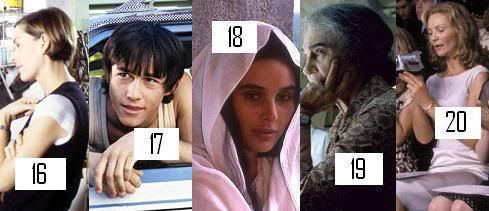 acters, and this is what proves to be the film's greatest achievement. Then we have Gregg Araki's Mysterious Skin, an effort I still am have trouble making up my mind about. But what I can affirm is that it packs a tremendous emotional punch, and even if you are put out by Araki's helming, it is impossible to not empathize with the two lead characters and their difficult journeys coming to terms with a shared, devastating childhood event. Deepa Mehta's Water has yet to open outside of Canada, but make sure you get a screening in when it opens near you in April (Fox Searchlight is distributing in the U.S.). It is a film that explores a restless time period in India's formation as a independent nation, as well as the oppressive power imbalances experienced by abused women, their only crime being widows. Steven Spielberg's Munich is next in line, and I salute him for venturing out into moral murkiness rather than moralizing as he has been prone to do. It is a difficult but rewarding film, and I look forward to a second viewing soon. Finally, there is Mike Binder's The Upside of Anger, a film that warrants consideration besides Joan Allen and Kevin Costner's acclaimed performances. It is far from a perfect piece, but it has a gigantic heart, having the ability to warm even bitter cynics such as myself. If you can leave small quibbles (such as the ending) at the door, there is great enjoyment to be had herein.
Someone, anyone...
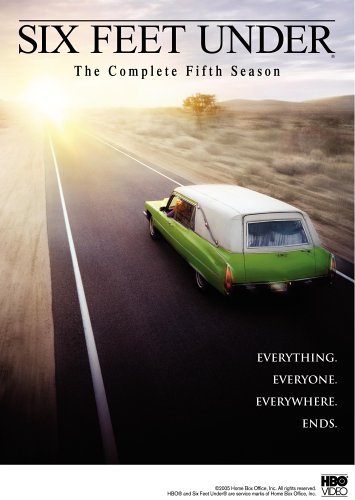 ...please buy this for me. I cannot live without it. Actually I could, but here's the dilemma. I could either buy this, or two weeks' worth of bus/subway tickets to get to school and back. What to do...
P.S. - Speaking of great HBO shows, I am really quite taken with Big Love, which I was very suspicious of initially. It sidesteps sensationalism and exaggeration (for the most part), and delivers more family dysfunction for our viewing pleasure. My only quibble is that Chloe Sevigny is - once again - playing the problem-causing bitch. Enough!
P.P.S. - Has anyone seen this Saturday Night Live spoof of another HBO treasure, Sex and the City? It had me laughing until my sides hurt. All of these actors do brilliant mimicry (particularly Christina Aguilera, who sounds so much like Kim Cattrall, it's frightening).
P.P.P.S. - Now that Blogger is finally accepting pictures once again, my 2005 Year in Review will commence shortly.
Monday, March 27, 2006
Assorted Musings
Must... update... blog. Provide... useless... commentary.
Orlando (Sally Potter, 1992) A- [Compressing four hundred years of personal and national history into roughly one and a half hours, Potter's adaptation of Virginia Woolf's novel about androgyny, politics and love frequently flirts with text surface skimming. This is the biggest flaw in an otherwise glorio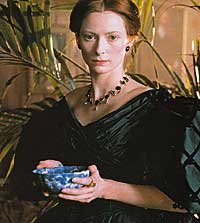 us cinematic experience (the equivalent of Russian Ark as visual museum piece, but in a British context), brought to life by a uber-talented production team. The glimpses into Orlando's life story may be brief and light on detail, but what a fleeting, thrilling journey through time it is! Sandy Powell, perhaps the most gifted costume designer in the industry working today, and the art direction team have a blast fashioning the characters' environments from the Elizabethan period through to the early 60s. And leading the way into this celebration of life is Tilda Swinton's extraordinary realization of this alluring figure, never once accentuating the shifts in gender identity, but internalizing them to the point where they become candid and spontaneous. As Orlando says to him/herself, "Same person. No difference at all... just a different sex". It probably does not come close to doing justice to the book (I am ashamed to say that I have not proceeded beyond twenty pages or so), but perhaps that was never Potter's aim in the first place. The film is better off for her employing Woolf's story as a starting ground to extrapolate new dimensions of this figure.]
Jarhead (Sam Mendes, 2005) B [Both the general public and critics came down hard on this film version of ex-marine Anthony Swofford's memoirs about the first Gulf War. The complaints seemed to aim at, in the former case, of the "boring" nature of the proceedings, while the reviewers focused on the lack of a context, focus or political commentary on Mendes's part. While I can understand these issues, 1) I rather enjoy deviations from the rah-rah, heavily violent structure of most war films, and 2) I don't think Mendes needed to explicitly make his anti-war statement (it's there if you look for it). The subjective slant to the events is a pleasant surprise, perhaps because the genre seeks to put as many soldiers as possible on equal terms. The desert landscape becomes a stand-in for Swofford's hollowness within, and Roger Deakins's hazy, desolate environments provide a reflection of this. The comparison made between waiting for conflict and the need to "get off" was rather ingeneous in my eyes, as well as the juxtaposing of the erotically-charged and violence. It obviously will not work for all tastes, but it is rather unique in its aims as a methodical, imagery-rich anti-war film. Think of it as a Gulf-War version of Gus Van Sant's Gerry.]
Brothers (Susanne Bier, 2004) B+ [In theory, on paper, by all accounts: this film should not work. It has all the makings of a rather distasteful melodrama, not far from Michael Bay's outlandish Pearl Harbor soap-opera with dead husbands returning from the dead to complicate newly-made love affairs. In the initial moments, I thought I had this production all figured out, believing that there was only one direction the set-up could lead. Much to my pleasant surprise, Bier completely turns the formula on its head, offering instead a complex tale that is equal parts family drama and anti-war statement. The screenplay frequently keeps the audience on edge, straddling the line between the seemingly perfect appearances and the dark secrets of human behaviour. Just as David Cronenberg masterfully explored the family dynamic in A History of Violence, by the end it is clear that Bier has also reached profound levels of insight into this damaged unit. The ensemble is uniformally excellent, but Connie Nielsen is the standout here; from the moment I saw her in Gladiator, I knew she would be able to carry a film on her own if someone gave her the chance (I have not seen Assayas's demonlover, although I should).]
Rent (Chris Columbus, 2005) C [I have never seen the original off-Broadway/on-Broadway show, but sadly I can't say the film incarnation whet my appetite to seek it out one day. I understand that in order to enjoy Jonathan Larson's much-celebrated re-imagining of La Boheme, you have to buy into the world he creates, wholly and without reservation. But the way in which the work shamelessly and ludicrously yanks the viewers' heartstrings did not succeed in winning me over. The first act is engaging and amusing enough, introducing us to the diverse web of characters living in New York, struggling to make sense of their financial, romantic and professional lives. But what follows thereafter is a mess of irrational, unexplained conflicts based around misunderstandings and mistrust. Angel's sickness is employed to create a temporary rift between the friends, which feels weak and without basis. Proceedings feel elongated beyond necessity, and several musical numbers feel extraneous. The ending is a disaster in itself; perhaps on stage such cloying sentimentality works, but certainly not here. Overall, the music is effective enough, with only two stand-out numbers among the bunch - "Seasons of Love" and "La Vie Boheme" (both are easily the best sequences in the entire film). The cast is largely decent overall, although ironically, the two new additions (not having appeared in the original 1996 production) prove to be the standouts (particularly Rosario Dawson, who captures the spirit if not the look of a nineteen-year-old). The others' performances range from solid (Adam Rapp) to out-right appalling (Idina Menzel).]
Murderball (Henry Alex Rubin, Dana Adam Shapiro, 2005) B+ [An absolutely thrilling sports film, highly preferable to feel-good shlock like Remembering the Titans and Miracle. Directors Rubin and Shapiro make nary a ill-conceived step here, refusing to sentimentalize the lives of these athletes as triumph over adversity cliches. The film tracks a couple of years in the lives of these teammates as they train for various quad rugby tournaments, particularly those of Mark, Joe and Andy, although other peripheral characters are showcased. I especially felt for Joe's son Robert, who reminded me of myself at a young age (I hated sports and resented anyone who tried to push me into them). If there's a flaw, I felt the American-Canadian antagonism was a little too convenient to generate the film's thrust, but I'll be damned if it didn't work on me at the time. What is more admirable about the documentary is that it manages to be inspiring without a shred of manipulation. It also features, in this regard, possible the best closing sequence in any film released this year.]
Kings and Queen (Arnaud Desplechin, 2004) B [A sublimely rich emotional experience. The central character is Nora, yet the film is driven by the various conflicts and pressures created by the men in her life (father, fiancee, ex-husband, son). Even her dead husband makes an appearance, in what is one of the best scenes of the year (similar to the o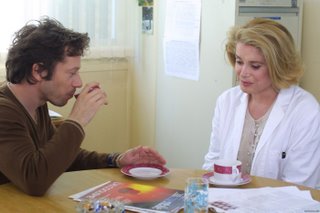 pening of John Madden's Proof). It would be difficult to classify this production as a comedy or tragedy, but this is the its greatest strength (a unique blend of melodrama and burlesque). Emmanuelle Devos is marvellous in the lead role, coming across as a real woman with palpable fears, desires and strengths. But the scene stealer here is the uproarious Mathieu Amalric, whose giddy and high-wire acting work as Nora's mentally unstable ex ranks among the best of the year. But unfortunately, Desplechin and his troop begin to wear out their welcome. The plot is refreshingly complex, but stretching it out to two-and-a-half hours is hubristically indulgent. Kings quickly goes from quirky to repetitive. This may seem like a small quibble, yet some more judicious editing would have made Kings and Queen a great film instead of a merely a good one with its moments. Deleting fifty minutes or more would have made a major difference.]
Sin City (Robert Rodriguez, Frank Miller, 2005) C [Cheap and soulless, watching Sin City was like listening to an audio commentary of characters narrating all of their actions on-screen. For example: "I look up at the bastard. He's smilin' at me with those dead, taunting eyes, and I think of Blondie. Who killed yuh Blondie? I'm bettin' it's this guy. I reach for my gun, but he's too quick for me. Before I know it, there's a bunch of guys kicking the crap out of me and all I can think of Blondie. I start laughin' at them and spit blood in their faces. Oh Blondie... I'll get 'em for yuh. And I'll rip 'em to shreds." Etcetera, Etcetera, please kill me and put an end to my misery. This is not visionary or daring work; it's just sick with no substance or subtext. Sure, the artistry behind the scenes is commendable, but it is in service of over-stylized and bombastic crap. Some have come to the defense of the film, seeing as it supposedly empowers women and is true to its gritty source material. Please. The only thing this film does is exploit its characters to get the audience off, be it for their flesh, blood or innocence.]
Orlando (Sally Potter, 1992) A- [Compressing four hundred years of personal and national history into roughly one and a half hours, Potter's adaptation of Virginia Woolf's novel about androgyny, politics and love frequently flirts with text surface skimming. This is the biggest flaw in an otherwise glorio
 us cinematic experience (the equivalent of Russian Ark as visual museum piece, but in a British context), brought to life by a uber-talented production team. The glimpses into Orlando's life story may be brief and light on detail, but what a fleeting, thrilling journey through time it is! Sandy Powell, perhaps the most gifted costume designer in the industry working today, and the art direction team have a blast fashioning the characters' environments from the Elizabethan period through to the early 60s. And leading the way into this celebration of life is Tilda Swinton's extraordinary realization of this alluring figure, never once accentuating the shifts in gender identity, but internalizing them to the point where they become candid and spontaneous. As Orlando says to him/herself, "Same person. No difference at all... just a different sex". It probably does not come close to doing justice to the book (I am ashamed to say that I have not proceeded beyond twenty pages or so), but perhaps that was never Potter's aim in the first place. The film is better off for her employing Woolf's story as a starting ground to extrapolate new dimensions of this figure.]
Jarhead (Sam Mendes, 2005) B [Both the general public and critics came down hard on this film version of ex-marine Anthony Swofford's memoirs about the first Gulf War. The complaints seemed to aim at, in the former case, of the "boring" nature of the proceedings, while the reviewers focused on the lack of a context, focus or political commentary on Mendes's part. While I can understand these issues, 1) I rather enjoy deviations from the rah-rah, heavily violent structure of most war films, and 2) I don't think Mendes needed to explicitly make his anti-war statement (it's there if you look for it). The subjective slant to the events is a pleasant surprise, perhaps because the genre seeks to put as many soldiers as possible on equal terms. The desert landscape becomes a stand-in for Swofford's hollowness within, and Roger Deakins's hazy, desolate environments provide a reflection of this. The comparison made between waiting for conflict and the need to "get off" was rather ingeneous in my eyes, as well as the juxtaposing of the erotically-charged and violence. It obviously will not work for all tastes, but it is rather unique in its aims as a methodical, imagery-rich anti-war film. Think of it as a Gulf-War version of Gus Van Sant's Gerry.]
Brothers (Susanne Bier, 2004) B+ [In theory, on paper, by all accounts: this film should not work. It has all the makings of a rather distasteful melodrama, not far from Michael Bay's outlandish Pearl Harbor soap-opera with dead husbands returning from the dead to complicate newly-made love affairs. In the initial moments, I thought I had this production all figured out, believing that there was only one direction the set-up could lead. Much to my pleasant surprise, Bier completely turns the formula on its head, offering instead a complex tale that is equal parts family drama and anti-war statement. The screenplay frequently keeps the audience on edge, straddling the line between the seemingly perfect appearances and the dark secrets of human behaviour. Just as David Cronenberg masterfully explored the family dynamic in A History of Violence, by the end it is clear that Bier has also reached profound levels of insight into this damaged unit. The ensemble is uniformally excellent, but Connie Nielsen is the standout here; from the moment I saw her in Gladiator, I knew she would be able to carry a film on her own if someone gave her the chance (I have not seen Assayas's demonlover, although I should).]
Rent (Chris Columbus, 2005) C [I have never seen the original off-Broadway/on-Broadway show, but sadly I can't say the film incarnation whet my appetite to seek it out one day. I understand that in order to enjoy Jonathan Larson's much-celebrated re-imagining of La Boheme, you have to buy into the world he creates, wholly and without reservation. But the way in which the work shamelessly and ludicrously yanks the viewers' heartstrings did not succeed in winning me over. The first act is engaging and amusing enough, introducing us to the diverse web of characters living in New York, struggling to make sense of their financial, romantic and professional lives. But what follows thereafter is a mess of irrational, unexplained conflicts based around misunderstandings and mistrust. Angel's sickness is employed to create a temporary rift between the friends, which feels weak and without basis. Proceedings feel elongated beyond necessity, and several musical numbers feel extraneous. The ending is a disaster in itself; perhaps on stage such cloying sentimentality works, but certainly not here. Overall, the music is effective enough, with only two stand-out numbers among the bunch - "Seasons of Love" and "La Vie Boheme" (both are easily the best sequences in the entire film). The cast is largely decent overall, although ironically, the two new additions (not having appeared in the original 1996 production) prove to be the standouts (particularly Rosario Dawson, who captures the spirit if not the look of a nineteen-year-old). The others' performances range from solid (Adam Rapp) to out-right appalling (Idina Menzel).]
Murderball (Henry Alex Rubin, Dana Adam Shapiro, 2005) B+ [An absolutely thrilling sports film, highly preferable to feel-good shlock like Remembering the Titans and Miracle. Directors Rubin and Shapiro make nary a ill-conceived step here, refusing to sentimentalize the lives of these athletes as triumph over adversity cliches. The film tracks a couple of years in the lives of these teammates as they train for various quad rugby tournaments, particularly those of Mark, Joe and Andy, although other peripheral characters are showcased. I especially felt for Joe's son Robert, who reminded me of myself at a young age (I hated sports and resented anyone who tried to push me into them). If there's a flaw, I felt the American-Canadian antagonism was a little too convenient to generate the film's thrust, but I'll be damned if it didn't work on me at the time. What is more admirable about the documentary is that it manages to be inspiring without a shred of manipulation. It also features, in this regard, possible the best closing sequence in any film released this year.]
Kings and Queen (Arnaud Desplechin, 2004) B [A sublimely rich emotional experience. The central character is Nora, yet the film is driven by the various conflicts and pressures created by the men in her life (father, fiancee, ex-husband, son). Even her dead husband makes an appearance, in what is one of the best scenes of the year (similar to the o
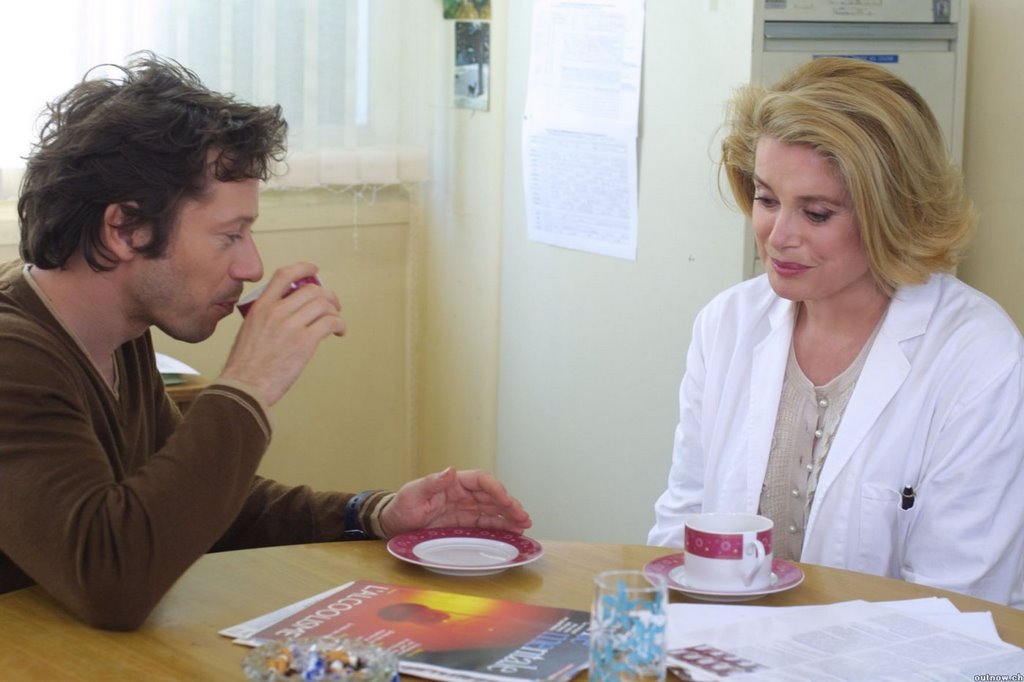 pening of John Madden's Proof). It would be difficult to classify this production as a comedy or tragedy, but this is the its greatest strength (a unique blend of melodrama and burlesque). Emmanuelle Devos is marvellous in the lead role, coming across as a real woman with palpable fears, desires and strengths. But the scene stealer here is the uproarious Mathieu Amalric, whose giddy and high-wire acting work as Nora's mentally unstable ex ranks among the best of the year. But unfortunately, Desplechin and his troop begin to wear out their welcome. The plot is refreshingly complex, but stretching it out to two-and-a-half hours is hubristically indulgent. Kings quickly goes from quirky to repetitive. This may seem like a small quibble, yet some more judicious editing would have made Kings and Queen a great film instead of a merely a good one with its moments. Deleting fifty minutes or more would have made a major difference.]
Sin City (Robert Rodriguez, Frank Miller, 2005) C [Cheap and soulless, watching Sin City was like listening to an audio commentary of characters narrating all of their actions on-screen. For example: "I look up at the bastard. He's smilin' at me with those dead, taunting eyes, and I think of Blondie. Who killed yuh Blondie? I'm bettin' it's this guy. I reach for my gun, but he's too quick for me. Before I know it, there's a bunch of guys kicking the crap out of me and all I can think of Blondie. I start laughin' at them and spit blood in their faces. Oh Blondie... I'll get 'em for yuh. And I'll rip 'em to shreds." Etcetera, Etcetera, please kill me and put an end to my misery. This is not visionary or daring work; it's just sick with no substance or subtext. Sure, the artistry behind the scenes is commendable, but it is in service of over-stylized and bombastic crap. Some have come to the defense of the film, seeing as it supposedly empowers women and is true to its gritty source material. Please. The only thing this film does is exploit its characters to get the audience off, be it for their flesh, blood or innocence.]
Monday, March 06, 2006
The Morning After...
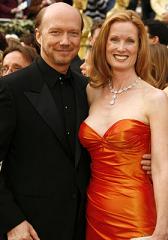 Er. Well chums, I'm trying really, really hard to be happy for Crash and the people behind it (they were just as shocked as we all were). As much as I spew hatred against it every once in a while (and inevitably will in the future), I do think it's a film with merits and one that was made with the best of intentions (*cough*). Plus, it's not even the worst Best Picture winner of the new milennium - that "honor" is accorded to Ron Howard's A Beautiful Mind. Anyways, although it's hard to swallow a Brokeback Mountain defeat after months of hype and steamrolling (has a film ever grabbed LA/NY/GG/PGA/DGA/WGA/BAFTA/ISA and not won Best Pic before?), we can rejoice in the fact that years from now, the Academy will look incredibly lame (as always) for not choosing something better (like... any of the other nominees). Brokeback has become bigger than anyone could have hoped for, and while the phenomenon has had its downsides (how many more parodies and jokes will we have to endure?), it was a pretty cool experience overall. And fans are not likely to shut up about the upset anytime soon... Ultimately, I'm just happy that Ang Lee won.
The ceremony overall? Thoroughly enjoyed it. Aside from the obvious aforementioned disappointment, I was impressed at how crisp and efficient the proceedings were, and, of course, by Jon Stewart's excellent performance as host. Maybe I'm overpraising him because Chris Rock sucked so badly last year, but I haven't enjoyed a telecast as much as this one since 2000.
The Citations for "Special" Behavior During the Oscar Telecast:
Best Line: Came right after one another during Stewart's opening monologue: "[Between] Munich and Schindler's List... I think I speak for all Jews when I say: I can't wait to see what happens to us next... Trilogy!" and "I do have some sad news to report. Bjork couldn't be here tonight; she was trying on an Oscar dress and Dick Cheney shot her". That last one made me fall off my sofa.
Celebrity who most resembles a melted Barbie doll: Dolly Parton, desperately hopping across the stage singing "Travellin' Thru".
Most Awkward Moment of the Night: Lauren Bacall, forgetting how to read and speak at the same time while introducing an utterly unnecessary tribute to film noir (honestly, who gives a fuck?).
The Lauren Bacall Award for Distinction in Speaking: Colleen Atwood, accepting her Best Costume trophy for Memoirs, speaking haltingly. like. this. for. her. entire. speech.
The "Please Get a Haircut, you're not in your 30s anymore" Award: Tom Hanks. Does he think he looks good? Or that it makes him look younger?
Most Shocking (and Deserving) Winner: "It's Hard Out Here for a Pimp" from Hustle & Flow, which beat out the sentimental favorites.
Best Speech: Gavin Hood, accepting Best Foreign Language Film for Tsotsi. How genuinely refreshing to see someone excited to take the stage. Also Reese Witherspoon - how genuinely refreshing to see an actor feel proud of her work and not resort to fake self-effacing "humility".
"Why Can't Any of You Pronounce My Fucking Name Properly or even Consistently?": A special prize presented by Ziyi Zhang to anyone who has ever introduced her.
The Annual Travesty Committed by the Academy: Dion Beebe, for the hideous Memoirs, beating four other nominees who all did superior work.
Most Generous Bosom: Jennifer Garner (also a winner for Best Recovery after an almost-fall; previous winners in this category include Goldie Hawn and Jamie Lee Curtis).
Most Distracting, Misbehavin' Audience Members: Catherine Keener and George Clooney obnoxiously chatting thru the entire ceremony. Shut up, the both of you! ... Naw, just kidding. Do whatever the hell you want.
The "Why the Hell were You Invited?" Award: J Lo and hubby. Seriously, why?
The "You're Not Funny or Talented no matter how many languages you can mangle, Get Off the Stage" Award: Will Smith.
Unintentionally Hilarious Moment of the Night #1: Struggling L.A. actors doing an interpretive dance to the scenes of Crash during the song performance of "In the Deep". *wipes away tear*
Best Follow-up to UHMOTN#1: Jon Stewart - "If I were trying to escape from a burning car, I would not be moving in slow motion".
Unintentionally Hilarious Moment of the Night #2: Yet another montage celebrating how socially progressive the Academy is. Cue clips from Driving Miss Daisy, Philadephia and the rest... Bleurgh.
Most Overdone (and Overrated) Introduction: Lily Tomlin and Meryl Streep wasting valuable time. Girls: we got it - five minutes ago.
Best Host Since Billy Crystal: John Stewart. Bravo!
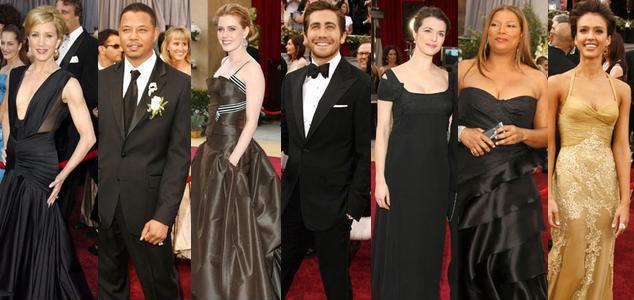 Best Dressed? I have to say, I failed to be wowed by any single person this year, perhaps with the exception of Jessica Alba, who was the only personality I'd call a real pleasure to look at. The color really worked for her skin, and although I'm not sure about the bottom half of the dress, she looked pretty damn good overall (the hair, the earrings, the teeth, the whole package). As for the others, black or darker colors really reigned the night IMO. Felicity Huffman thankfully lost Best Actress, but I'd have no problem calling her one of the few stunners of the night; loved the cleavage, loved the color, loved the hair. Rachel Weisz reminded me instantly of Catherine Zeta Jones circa 2003 (the year she won Best Supporting Actress), but looked ten times better. I was worried about her after the GG fiasco; thankfully, she went understated (which is always better for her). Amy Adams was glorious overall; the striped trimming around her chest and waist was a classy touch, and the blue matched her earrings. Also wowza was Queen Latifah, who also gets points for being the liveliest presenter tonight (if only all of them were as jovial as her). Men are harder to acknowledge for fashion choices, but at the top of the list were Terrence Howard and Jake Gyllenhaal, who somehow manage to look GQ all the frickin' time. Damn them! Worthy runner-ups: Reese Witherspoon, Hilary Swank, Jada Pinkett-Smith, Meryl Streep.
The following also looked great, but it was like they were struggling to keep their tiny dresses from falling
 off their even tinier bodies. I don't know if the separation from Chad has been especially stressful for Hilary Swank, but she looked much tinier than she did last year (is it because Million Dollar Baby had just wrapped a couple of months before?). Keira Knightley was getting a lot of compliments from the E! interviewers, but I didn't think she looked all that great. The necklace was a bold accent, but the dress colour was horrid, clashed with her hair and to make matters worse, she appeared smaller than one of those rotting skeletons from Pirates of the Caribbean. She would look so much more attractive if she gained five to ten pounds, just saying is all. Finally, Ziyi Zhang was cute and chic (like the bodice a lot), but it took me a second to recognize her - she looked like a ten year old kid! I know most of these actors are naturally waif-like, but it was just too difficult to look at them without cringing. I'll take all you ladies out to dinner (my treat), as long as you promise to eat. Carbs. Lots of them.
Worst Dressed? Oh dear. Well, there were some truly hideous selections to choose from, starting with Miss Dolly Parton; I totally understand that it's hard to find a great dress when you're a petite, well-endowed woman, but I don't think this dress does her any good. The fact tha
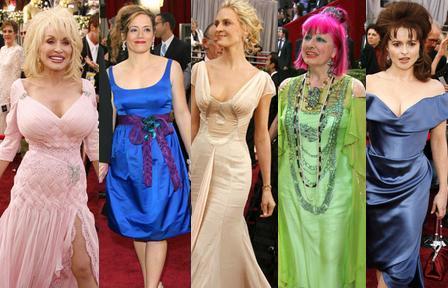 t she's thrusting her assets out like that doesn't help much either. The woman next to her (yeah, the one mixing purple, blue and green) was Philip Seymour Hoffman's date (his wife? EDIT: His girlfriend, Mimi O'Donnell). Either way, she's quite the eyesore... It hurts to put Uma Thurman here, because she's far from the worst-dressed. But she looked totally washed out - her skin, hair and dress all made her resemble a freshly-painted wall. The less said about Zhondra Rhodes, the better; I know she's an unorthodox, daring designer, but this outfit is frankly hideous, I'm sorry. Finally, Helena Bonham Carter is just screaming for a makeover (she just doesn't consciously know it); for fuck's sake, that hairstyle has remained the same for the last fifteen years! I'm abstain from Corpse Bride jokes, but she needs serious help... now!
This category is "Points for trying, but no cookie", which acknowledges effort and hands out constructive criticism. Firstly, there's Bahar Soomekh, who played the Iranian storeowner's daughter in Crash; the color
 was fitting on her, but the excessive doilies around the chest and waist were unflattering - simple is better. Naomi Watts (looking positively ill throughout - was it Heath/Michelle jitters?) had the same problem - the extra frilly material across the top half was annoying. Jennifer Aniston looked fine for the most part, but the ensemble is very boring; it's like I've seen that dress on her 5,000 times. Black is okay Jen, but try experimenting with color next time. It can be cathartic. I don't know quite what to make of Charlize Theron's efforts here; every time I look at time, I have a different reaction. I certainly don't hate it, but the fluff on her left shoulder is distracting, and the hairstyle makes her look then years older than she really is. Finally, Michelle Williams's dress fit her to a "T", but the bright color didn't work for her pale skin, nor did the bright red lipstick (she looked like a clown at times).
And... I'm spent.
Saturday, March 04, 2006
Teh Winners
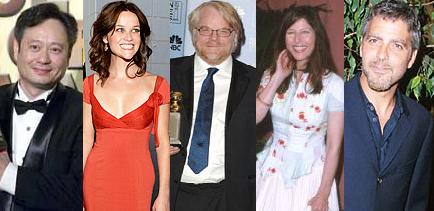
 So... they're finally here. After months of deliberation, reviewing and odds-making, it's time to finally kiss 2005 good-bye, setting in stone (hah!) the "Best" (hah!) of the year in terms of film. It's been a lot of fun (ha-- no, it really has actually), but I'm sure even the biggest Oscar enthusiast is shouting "Enough is enough!". I personally love awards season, but I have to admit that I'm exhausted and, moreover, bored. I want it all to end. Not that anyone will have to twist my arm into watching tomorrow, but after sitting through awards ceremony after awards ceremony, I'm not expecting a lot of surprises or changes in the overall voting trends. Every year I desperately hold out for upsets, and I turn away disappointed (see last year, where SAG, DGA and WGA influenced every category - yawn). So I'm trying to get myself excited; not for any last-minute shockers (although they're certainly welcome), but for the following (in roughly this order): Jon Stewart's performance, the dresses (duh), the acting clips (my favorite part), "It's Hard Out Here for a Pimp" (just to see how they pull off this PG version), and Ang Lee winning the Oscar he deserved back in 2001. I also enjoy the Red Carpet coverage somewhat, minus the stupid, annoying reporters (The Antichrist isn't going to be anywhere near the Kodak Theatre, is she? Please reassure me, someone, anyone...)
BEST PICTURE
Prediction: Brokeback Mountain
Preference: Capote
Upset: Crash
- Although I have Paul Haggis's film second-in-line, it's still not likely. Every year, the media tries to inject some suspense into this race, pitting secure locks against films with no chance (LOTR vs. Mystic River; A Beautiful Mind vs. Moulin Rouge). Bless them writers and their noble efforts, but it's not going to work. I recently caught Crash again a couple of days ago (for the first time in a year-and-a-half), and while I liked it considerably more this time around (seeing it warts and all), it just doesn't feel like a Best Picture winner. The Academy will surely reward it in other categories (Original Screenplay, Song and Editing look likely), not to mention that they usually like the Picture and Director winners to match (Return of the King, Million Dollar Baby most recently).
BEST DIRECTOR
Prediction: Ang Lee, Brokeback Mountain
Preference: Bennet Miller, Capote or Ang Lee, Brokeback Mountain
Upset: George Clooney, Good Night, and Good Luck
- There is no way on earth that Ang Lee loses this. Best Picture is still up in the air, but this category is settled. If he loses this in spite of previously winning the Golden Globe and the DGA prize (again), the universe will rupture.
BEST ACTRESS
Prediction: Reese Witherspoon, Walk the Line
Preference: Reese Witherspoon, Walk the Line Upset: Felicity Huffman, Transamerica (Please God no).
- Reese Witherspoon is the saving grace of this horrid category, and I hope the voters feel the same way (obviously not, since they voted for all these lame nominees in the first place!). I'm really quite terrified of the thought that one day I'll have to walk by the "T" shelf at the video store and have to endure the Transamerica DVD cover screaming "Academy Award Winner: Best Actress - Felicity Huffman". I actually had a dream (nightmare) a couple of days ago that she won. Let's hope that my dreams never come true. And considering the precursors, there's a good chance that they won't.
BEST ACTOR Prediction: Philip Seymour Hoffman, Capote
Preference: Heath Ledger, Brokeback Mountain (Terrence Howard was great too)
Upset: Heath Ledger, Brokeback Mountain
- It's not likely that anyone can upset PSH here. If Brokeback wins an acting trophy, it will be a for a supporting performance.
BEST SUPPORTING ACTRESS
Prediction: Catherine Keener, Capote
Preference: Amy Adams, Junebug or anyone but Frances McDormand
Upset: Rachel Weisz, The Constant Gardener
- This is one prediction I am likely to regret making come early Monday morning, but I need to throw a wildcard in just to make this all interesting (and to distinguish my list from all the others). Rachel Weisz looks like a sure thing for many reasons, ranging from her prior awards to the "importance" factor of her film (this would be a good way of rewarding The Constant Gardener as a whole). But after taking in Capote for a second time, Catherine Keener's work really impressed me; she does so much with so little, and the performance sneaks up on you. I can see this happening a la Marcia Gay Harden in 2001 (although that was a co-lead while this very much is not). A vote for Keener would represent her body of work from 2005 (along with Jake Gyllenhall, this was very much her year) as well as right the wrong of Angelina Jolie walking away with her trophy back in 2000. I'm feeling this...
BEST SUPPORTING ACTOR
Prediction: George Clooney, Syriana Preference: William Hurt, A History of Violence (but since he has no chance, I'd vote for Jake)
Upset: Jake Gyllenhaal, Brokeback Mountain
- I really want to predict Gyllenhaal to take this award, because I can see the vote splitting between frontrunners Clooney and Giamatti. But the reality is that other than William Hurt (ironically giving the best performance in this bunch), any of these actors could take it. What pushes George over the others is his three nominations, and guilty-feeling voters will probably throw him a bone in this category. Otherwise, I'd be predicting someone else. At least he'll give a confident, funny speech (unlike Jake, who was painful to watch at the BAFTAs).
BEST ORIGINAL SCREENPLAY
Prediction: Paul Haggis, Bobby Moresco, Crash
Preference: Noah Baumbach, The Squid and the Whale
Upset: George Clooney, Grant Heslov, Good Night, and Good Luck
- Voters give Haggis a consolation prize for losing last year. Thankfully, the lame Match Point has no chance here.
BEST ADAPTED SCREENPLAY
Prediction: Diana Ossana, Larry McMurtry, Brokeback Mountain
Preference: Dan Futterman, Capote
Upset: Dan Futterman, Capote
- Best Picture or not, this category looks wrapped up.
And the rest...
BEST CINEMATOGRAPHY Prediction: Rodrigo Prieto, Brokeback Mountain Preference: Emmanuel Lubezki, The New World Upset: Robert Elswit, Good Night, and Good Luck
BEST EDITING Prediction: Hughes Winborne, Crash Preference: Claire Simpson, The Constant Gardener Upset: Claire Simpson, The Constant Gardener
BEST ART DIRECTION Prediction: John Myhre, Gretchen Rau, Memoirs of a Geisha Preference: Sarah Greenwood, Katie Spencer, Pride & Prejudice Upset: Grant Major, Dan Hennah, Simon Bright, King Kong
BEST COSTUME DESIGN Prediction: Colleen Atwood, Memoirs of a Geisha Preference: Arianne Phillips, Walk the Line Upset: Arianne Phillips, Walk the Line
BEST ORIGINAL SCORE Prediction: John Williams, Memoirs of a Geisha Preference: Gustavo Santaolalla, Brokeback Mountain Upset: Gustavo Santaolalla, Brokeback Mountain
BEST ORIGINAL SONG Prediction: "In the Deep", Crash Preference: "It's Hard Out Here for a Pimp", Hustle & Flow Upset: "It's Hard Out Here for a Pimp", Hustle & Flow
BEST MAKEUP Prediction: Howard Berger, Tami Lane, Chronicles of Narnia Preference: Dave Elsey, Annette Miles, Revenge of the Sith Upset: Dave Elsey, Annette Miles, Revenge of the Sith
BEST SOUND MIXING Prediction: Paul Massey, Doug Hemphil, Peter F. Kurland, Walk the Line Preference: Andy Nelson, Anna Behlmer, Ron Judkins, War of the Worlds Upset: Boyes/Semanick/Hedges/Peek, King Kong
BEST SOUND EDITING Prediction: Mike Hopkins, Ethan Van der Ryn, King Kong Preference: Mike Hopkins, Ethan Van der Ryn, King Kong Upset: Richard King, War of the Worlds
BEST VISUAL EFFECTS Prediction: Letteri/Van't Hul/Rivers/Taylor, King Kong Preference: Letteri/Van't Hul/Rivers/Taylor, King Kong Upset: Helman/Muren/Dutra/Sudick, War of the Worlds
BEST ANIMATED FILM Prediction: Wallace and Gromit: The Curse of the Were-Rabbit Preference: Wallace and Gromit: The Curse of the Were-Rabbit Upset: The Corpse Bride
BEST FOREIGN LANGUAGE FILM Prediction: Tsotsi Preference: ? Upset: Paradise Now
BEST DOCUMENTARY FEATURE Prediction: March of the Penguins Preference: Haven't seen them all, but I was quite taken with Murderball Upset: Darwin's Nightmare ....
TALLY: Brokeback Mountain - 4 Crash - 3 Capote - 2 Memoirs of a Geisha - 3 King Kong - 2 Walk the Line - 2 Chronicles of Narnia - 1 March of the Penguins - 1 Syriana - 1 Tsotsi - 1 Wallace and Gromit: The Curse of the Were-Rabbit - 1
Happy watching, everyone!
Sunday, February 26, 2006
Bollywood's Bodacious Bash
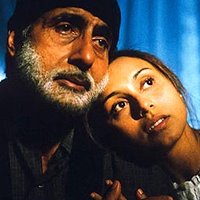 On Saturday night, Bollywood (or if you prefer, the Hindi-language film industry)'s equivalent of the Oscars took place. Admittedly, the Filmfare Awards and their uninspired choices every year constitute an institution that I rarely can muster excitement about (not only for constantly overlooking independent parallel cinema and favoring commercial fluff, but especially in terms of how votes are accumulated and weighted - half the movie-going public, half a jury composed of five or six industry members), but this year was a very nice surprise. I think history was created in that Black, the film which swept all the major categories (a whopping 10 [EDIT: 11, actually] in total), is a film that features none of the conventions of a mainstream Bollywood flick - no songs and dances, no comic relief, a two-hour running time, and the absence of a romantic track; what's more, the majority of the film is in English! Of course, this isn't much of a surprise; although the film released almost a year ago in February of 2005, it's been a virtual lock for the big four: Best Film, Best Director (Sanjay Leela Bhansali), Best Actor (Amitabh Bachchan) and Best Actress (Rani Mukerji), if not everything else. Hopefully this will push directors and writers to understand that art films can be commercial and critical successes - Black isn't exactly light-hearted fare (a loose re-working of William Gibson's The Miracle Worker) and it still made 20 crores-plus at the Indian box office (roughly $5 million U.S. or thereabouts).
Although I'm a little miffed that Rani Mukerji scooped up her second consecutive Best Actress win (why?), I can't argue with Bachchan and Ayesha Kapoor (Best Supporting Actress) winning in their respective categories. It was also great to see Sanjay Leela Bhansali win Best Director again (his third trophy in the last seven years). If he keeps working on his craft (less melodrama and excess, more trusting his audience), there's no reason why his films can't compete at the international level in the years to come. He certainly has the eye for composition and an ear for dialogue; now he just needs to make the leap from offering visual feasts to developing substantial ideas, themes, etc.
The best moment of the night was Madhuri Dixit's triumphant return to the stage in an abridged dance performance blending together three of her song sequences in Devdas (also directed by Bhansali back in 2002). Dixit (who was reigning queen during the early-to-mid 90s) is an actress whose work has been more interesting post-marriage, when her scr
 een appearances became less frequent. Although the quantity of her output fell, the quality of her acting work skyrocketed; her two supporting performances in Devdas and Lajja were award-worthy IMO (she won Best Supporting Actress for the former). I hope that Dixit is able to grace the silver screen again; producers have lost interest now that she's approaching the dreaded 40 mark (an unfortunate trend in this film world), but if the reaction to her appearance last night is any indication, the audience wants more (as do I). I just hope she's able to find better material than playing elder sisters or spinster aunts, relegated to the background where younger (but talentless) leads steal the limelight. Roles for women are much better now than they were a decade ago, but sexism and marginalization still exist. Maybe she'd do better going the parallel cinema route, banging on the doors of Shyam Benegal, Mani Ratnam, or perhaps SJB can write something great for her. One only needs to look at the career of Shabana Azmi to see that it is possible to have a career in your 40s and 50s; it's just that it may not be in commercial cinema.
Speaking of Shabana Azmi, she looked absolutely terrific while accepting her Lifetime Achievement Award. I can't find an appropriate picture, but believe me when I say that she looked dazzling. What was even more impressive was her succint, articulate speech in which she primarily gave tribute to all those behind the camera - technicians, artists and other talents - that rarely get acknowledgment (indeed, the Filmfare Awards has yet to create competitive categories for Art Direction, Cinematography, etc - they have a separate jury which just votes on a winner).
Otherwise, the night was ho-hum. Abhishek Bachchan (Amitabh's son) picked up another win for Best Supporting Actor (he also won last year for Yuva) for a rather bland piece of work. I was taken aback to see Will Smith there (who presented Best Actress); he's also set to appear on Indian Idol later this week. Paheli, which was submitted as India's official selection to the Oscars, unsurprisingly came out empty-handed (it received very few nominations in the first place). Trailing Black with five trophies was Pradeep Sarkar's Parineeta (Art Direction, R.D. Burman Award for Achievement in Music, Sound Design, Choreography and Female Debut [Vidya Balan]), and then Bunty Aur Babli, which garnered three (Musical Score [Shankar, Ehsaan and Loy], Lyrics [Gulzar] and Female Playback Singer). In something of an upset, the low-key Page 3 won Best Screenplay (I suppose I'll have to see this now).
Best Dressed? Best Actress winner Ran
 i Mukerji (here with her father):
Friday, February 17, 2006
Emmy Voters: For Your Consideration... or else
 Warning! This post contains Season Five spoilers... Whenever I need my fix of the late great HBO series Six Feet Under, I pop in a DVD from any given season to visit these great, witty and (most importantly) incredibly fucked-up characters for an episode or two. Of course, what inevitably ends up happening is that I end up watching the entire season (in one sitting) and then moving onto the next set to follow what happens (phht, as if I don't know what happens already). Yes, I've come to realize that I need the Fishers, Chenowiths and Diaz's in my life always; the show has become such a part of who I am (I'm as good as quoting this material as I am with The Simpsons). This past week, I watched all of Season Two and have now forced myself to hide Season Three before I start in on that too; after all, there are other shows to catch up on, such as Grey's Anatomy (for some reason, I didn't like this show when it first aired back in March, but now on DVD, it's actually proving to be a lot of fun. Anyways, anything with Sandra Oh is worth watching).
Six Feet Under recently aired in its fifth - and final - season (*SEASON FIVE SPOILERS FROM HERE*). For some viewers and critics, the farewell was more than welcome (if not overdue by two seasons or so), and for others, it was extremely hard to let go. I myself have my quibbles with the writers' choices over the last few years, I must admit - halfway through Season Three, the gloom and doom started to seriously overpower the humour, and Season Four overall was... well, not a disaster, but definitely disjointed and underwhelming. It's clear that Alan Ball and his writing team wrote themselves into a corner (granted, Lisa wasn't the most likable character, but the manner in which she was offed [and the reasoning behind it] was weak). Still, Season Five more than delivered; it may have been the best work the writers have done since the first batch of episodes. Not only did they have the balls to kill off Nate, but they did so 1) at his most unlikable moment; 2) when there were four more episodes left to air; and 3) when he's (arguably) the lead of the show. Risky! But more than that, the show refused to let us wallow in simple, expected conclusions - Brenda and Nate weren't meant to be together after all (damn!), Maya loses both her parents in her first few years of life, etc. It all affirmed for me why I respect the series so much - while people complained about the pessimism and bleakness of this world, it felt truthful to me. Death, depression, pain and hatred are not given superficial treatment here; Six Feet Under took us to those lows, refusing to let us off the hook easily. We experienced every horrible and heart-wrenching moment in its darkness; just watch the episode of Nate's funeral, and you'll know what I mean.
Which brings me to the point of this entry... although the series has come to an end, I don't have closure - not at all. It may seem immature to say so (and I know awards are popularity contests), but I won't be able to end on good terms with the show until the Emmy nominations are announced and trophies are handed out. Watching these episodes over an
 d over again over the past few years, I've been completely blown away by the quality of the acting. Hard as it is to believe, Six Feet Under, aside from a prize for Patricia Clarkson as Aunt Sarah (Outstanding Guest Actress in a Drama Series - 2002), has not won a single acting trophy. The first year the series premiered, it got nominations across the board for pretty much every prominent actor associated with the series (aside from Matthew St. Patrick and Justina Machado). But year after year, the nominations have subsided (understandable - the series wasn't getting a lot of love after Season Two), and although writing/directing snubs were justified, acting omissions were not. The acting has been stellar since the pilot, and every single performer has made a case for serious award-age. Three actors who definitely should have won an Emmy by now IMHO - Rachel Griffiths (Season One), Peter Krause (Season Three/Four), and especially Frances Conroy (pick any goddamn season! She's perfection in every single episode!!!).
Many of you are probably rolling your eyes and probably asking why the show needs validation from the ridiculous Emmys. Maybe so... but if Patricia Heaton can win Best Actress two years in a row for repeating her whiny, annoying "acting" in Everybody Loves Raymond, why can't Frances Conroy win one single prize for her Oscar-worthy work? It's like the same Hilary Swank argument all over again - why does she have two while Julianne Moore and Patty Clarkson have zero (note - I think Swank deserved her first Academy Award)?
The Golden Globes have been quick to embrace the show (it won Best Drama and Best Supporting Actress [Rachel Griffiths] in 2002, and Best Actress [Frances Conroy] in 2004). It's won two SAG Ensemble Cast prizes (two years in a row) and one Best Actress "Actor" statuette for Conroy. What's with the delay, Emmy voters? Thankfully, you have one more chance to get it right. Please (if this rant somehow reaches you by chance of miracle), please correct your past oversights and give awardage where awardage is due. I'm not asking for a Six Feet Under sweep - maybe just in the acting categories. At the very least, give Frances Conroy the Emmy she's deserved since Season One, Episode One (for her consistently brilliant work in every damn episode, even when the writing wasn't up to par).
Okay, I'm done. Ultimately, if Frances Conroy does not win Best Actress in a Drama this year, you are all warned that I will turn green and grow hundreds of feet and... HULK ANGRY! KILL EMMY VOTERS, SQUISH THEIR BRAINS MUSH THEIR FACES EFWATEW$IT^$3q6943yu ;h54wtwhky/w4ejoy32#@@###%%%%%%%
.... Just to let you know ahead of time.
Monday, February 13, 2006
Sure guys... sure
So here is an effort on Heath Ledger's part to explain his bizarre behaviour during that uncomfortable presentation with Jake of the Brokeback Mountain ensemble clip at SAG (scroll down to "Much Ado About... Heath at SAG"). Not that I don't feel the apology isn't genuine (or that the issue is being a little blown out of proportion, even though the delivery made  me raise an eyebrow myself), but this whole thing has just affirmed for me how immature the both of them (as well as the media - *cough*Oprah*cough*) have been acting this whole awards season. I am reminded of an excellent Advocate article by Charles Bouley - "It's very brave of them". This piece does a good job of exposing how ridiculous and regressive the reaction has been to Ledger and Gyllenhaal's work, calling them both courageous and incredibly daring (for what? Having to kiss?). Indeed, why is it so "brave" of them? Bouley argues that rather than bravery, he sees fear and homophobia on the part of the press and the film's two leads themselves. He questions the two actors for having to constantly assert their heterosexuality ("The idea that I had to make out with Jake... just wasn't the easiest thing to do" and "These aren’t gay guys, they’re two souls that fall in love." [huh?]), and I rather agree. It's pathetic how Heath and Jake constantly have remind us that they're straight and that playing lovers was oh-so-daunting and took a great leap of faith. Shut up, both of you. You're actors, it's your job to play people not like yourselves. Stop pretending you've done society a favour. Stop worrying that everyone thinks you're gay (we know you're not). Just stop talking.
Here's how the article ends, and they're my sentiments exactly...
 me raise an eyebrow myself), but this whole thing has just affirmed for me how immature the both of them (as well as the media - *cough*Oprah*cough*) have been acting this whole awards season. I am reminded of an excellent Advocate article by Charles Bouley - "It's very brave of them". This piece does a good job of exposing how ridiculous and regressive the reaction has been to Ledger and Gyllenhaal's work, calling them both courageous and incredibly daring (for what? Having to kiss?). Indeed, why is it so "brave" of them? Bouley argues that rather than bravery, he sees fear and homophobia on the part of the press and the film's two leads themselves. He questions the two actors for having to constantly assert their heterosexuality ("The idea that I had to make out with Jake... just wasn't the easiest thing to do" and "These aren’t gay guys, they’re two souls that fall in love." [huh?]), and I rather agree. It's pathetic how Heath and Jake constantly have remind us that they're straight and that playing lovers was oh-so-daunting and took a great leap of faith. Shut up, both of you. You're actors, it's your job to play people not like yourselves. Stop pretending you've done society a favour. Stop worrying that everyone thinks you're gay (we know you're not). Just stop talking.
Here's how the article ends, and they're my sentiments exactly...
Seems Hollywood is full of more cowards than heroes. So yes, kudos to Jake and Heath and Ang. But let’s get to a point where we can talk about the movie itself, not the sexuality of the characters playing the roles, as Jake and Heath have been trying to do. And let’s also get to a point where playing a gay person is not more courageous than playing a child molester or murdering mob boss.
Saturday, February 11, 2006
I need to do some schoolwork now

Mysterious Skin (Gregg Araki, 05) B [Compassionate, humanly funny and creepily exploitative all at once, this adaptation of Scott Heim's coming-of-age book is an assault on the senses (generally in a good way). Araki pushes the envelope with the disturbing subject matter, going to great lengths to depict harsh, gloomy situations (I am usually not squeamish and try to avoid censoring, but I admittedly had to forward through an excessively graphic rape scene). Yet he achieves just as many moments of tenderness while tracking the stories of two boys who share a history of abuse. Any person who has grown out of their teenage years can surely identify with the bittersweet, dreamy landscape of Araki's world. The usual themes of sexual self-discovery, family dysfunction, moving away and returning home are all present, but they are given a refreshingly novel treatment; these happenings come across as spontaneous and impulsive, as opposed to mechanically plot-driven. Overall, the film soars more often than it stumbles, and the closing moments are some of the most heartfelt I've witnessed in my years as a moviegoer. Joseph Gordon-Levitt is absolutely stunning in the lead; the role of the wayward, destructive hustler has become something of a cliché in recent years, but here Levitt brings a new dimension to the figure, who actually seeks out tricks not for money, but to gain validation and love. Brady Corbet is equally good in his moments as the introspective, stunted Brian, while the rest of the talented cast members (Mary Lynn-Rajskub, Elizabeth Shue, Bill Sage, and Michelle Trachtenberg) make lasting impressions despite minimal screentime.]
Mrs. Henderson Presents (Stephen Frears, 05) C+ [The first half here may be cheeky and irreverent, but that's the pretty much the appeal (and it effectively tickles the funny bone). Dench is at her liveliest in years, every word out of her mouth resembling comic gold (if such a thing exists). Bob Hoskins provides able support, and much fun ensues watching these two dominant personalities (and "ack-tuhs") duke it out for power in running the Windmill theatre. Really, these are the only two worth caring about because the script is otherwise fairly slight on character development (although Christopher Guest is fun as the uptight chancellor). The film continues on this high until Frears decides to get heavy-handed, using the war to inject severity in the on-goings. One supporting character is even pathetically disposed of as a plot device to drive home the realities of WWII (poor Kelly Reilly). But the ultimate offense is Henderson's final speech, which basically underlines the film's subtext (which was obvious enough without having to point it out); it's wholly unconvincing and leaves a bad after-taste (although Dench almost makes it work).]
The Virgin Spring (Ingmar Bergman, 60) B- [Pointlessly telegraphed from beginning to end, this morality tale is an oppressive, obligatory experience. From the very start, Bergman provides a contrast between the two protagonist sisters: one a bitter, unwed mother (Ingeri) and the other a beaming, spoiled woman-child (Karin), setting up the inevitable act to come ("Only a virgin can ride to church"). Although the revenge sequence planned by Tore (the girls' father, played by Max von Sydow) in the final act provides a chilling angle and introduces some intricacy (as well as Ingeri's disturbing confession about witnessing her sister's grim end), the complacent ending leaves no room for questioning or dissent. The punishment doesn't seem to fit the crime, and Bergman refrains from pointing out the problems with this, Tore's final intentions and the bursting spring itself.]
Munich (Steven Spielberg, 05) B [It's impossible to talk about this murky exploration of terrorism and revenge without looking back on Spielberg's recent work. In that respect, Munich represents a rejuvenating success, which feels like nothing the director has done before (although there are the occasional groan-inducing repetitions - i.e. the innocent children are everywhere!). As well, the grayness of the proceedings (reinforced by the lyrical writing by Tony Kushner) paints the film another layer, elevating it beyond one-note retaliation polemic. It borders on greatness more times than few, and the first two acts represent some of the best work Spielberg and his regulars (Kaminski, Williams, etc) have done in years (A.I. excepted). Taut, suspenseful and complex, the film is riveting until it reaches a creaky third wind where Spielberg resorts to familiar manipulation tactics. I don't think I need to call attention to Spielberg's bizarre juxtaposing of sex and death; enough have mocked it well.]
Transamerica (Duncan Tucker, 05) C [It is indeed heartening to see a message-conscious film like this break into the mainstream (although the pessimist in me suggests that it's more because of Felicity Huffman, the nature of her role and the hideous t.v. show she stars in than anything else), but it's unfortunate that the piece itself as a whole feels so stale, obvious and frustratingly gimmicky. Aside from recycling the clichés of the road-trip movie (they fight over the radio station, their car gets stolen, etc.), Duncan Tucker's screenplay always goes for the easy way out. Either hammering home societal ignorance ("Are you a boy or a girl?") or conveniently opening the door for familial reunion ("I'm going to go live with my dad"), the film is a vanilla, mediocre sitcom. More disturbing is the film's treatment of the peripheral characters; the other transsexual women portrayed are played up for laughs, while Bree's family members are cartoony in their intolerance (making their rushed character arcs all the more jarring). Oscar nominee Felicity Huffman seems to think she is playing an extra-terrestrial rather than a pre-op transsexual (and I'm not being glib - the approach is unintentionally bizarre). Although she is in earnest to bring this character to life (and the portrayal does has its winsome charms here and there), the effort sadly never feels natural. Her performance in the first half hour is appallingly ill-timed and then for the most part utterly see-through. The burden of keeping the film afloat then rests on Kevin Zegers's shoulders as Bree's druggie son, who veers between a hard-edged awareness about life and the raw vulnerability of a lost child looking for love.]
The White Diamond (Werner Herzog, 05) B- [It would be unfair to compare this to Grizzly Man, but it's really hard not to when the proceedings (and Herzog's unhelpful commentary) here mostly fail to stimulate or reach even a fraction of that prior film's genius. The first half here is strangely muted and the efforts to get the project up off the ground (flying an airship over the Guiana rainforest) are unappealing. Herzog's shaky, sloppy aesthetic is even more off-putting. As well, it's a shame that Mark Anthony Rhap (resident Guianan), the documentary's most interesting character, is sidelined to make room for scientist researcher Graham Dorrington's whiny, tedious monologues about his efforts in this project and his guilt about a colleague's death years ago. Yet the final few moments finally register as divinely inspired. Herzog earns points for not showing us the flight above from the perspective of the participants (best left to their privacy), instead inviting us to fly in the air, and immersing us in the natural landscape for ourselves in a stunning, breath-taking finale).]
La Promesse (Jean-Pierre and Luc Dardenne, 96) A [What I love about the Dardenne Brothers' work is that at the end of the day, there are no simple solutions. No happy endings here, no ways out of the grim realities of death, abuse and poverty. But at the same time, their world view is not cynical in the least; their approach is wholly humanistic, filled with compassion for all their flawed characters (even the ones who perpetuate violence and exploitation). The director-duo often focus on characters on the sidelines of society, bringing into focus stories that are ignored by the dominant media (mainly about those who live with little means).The documentary-style of the frame further adds to the immediacy, urgency and profundity on the happenings. The narrative set-up here is similar to that of their recent L'Enfant; the main conflict is a difficult moral issue, where the categories of right and wrong become ambiguous. Jeremie Rainier plays Igor, an adolescent placed in a most pressing situation, requiring wisdom beyond his years. Yet his big heart and sense of conscience leads him to perform the most extraordinary acts to fulfill the promise he makes to a dying immigrant. As the film goes on, the tension becomes almost unbearable as Igor attempts to hide his actions lest he is found out by his father (and severely punished). Not a shot here is ill-conceived - it's a genuine masterpiece. I simply can't wait to catch up on Rosetta and The Son.]
Friday, February 03, 2006
Something I've never seen before
Today, I went to see Mrs. Henderson Presents, and preceding the screening (during the previews) was a single trailer for... Mrs. Henderson Presents. I believe this is the first time something like this has ever happened in my years of being a moviegoer.
Wednesday, February 01, 2006
You're a winner in my eyes, Maria
 I really don't know what else to say about the Oscar nominations that were announced in the wee hours of Tuesday morn (ok, it was 8:30am here, but that's criminally early for a deep sleeper like me, k?) - everyone has already picked them apart better than I ever could. Needless to say, the results were fairly underwhelming, but I can't really complain (for the most part; see below) because I had a feeling that they'd be rather conventional this year, no surprises (I said as much in my predix). The biggest letdown was the Directors' category, which matched Picture 5/5 and did not feature any expected surprises like Cronenberg, Meirelles, or Wong. And although I liked Munich (how the hell did it rebound so well?), I was hoping that Spielberg would be snubbed to make room for a newcomer; does he really deserve yet another nomination? If the acknowledgment were for something truly great and transcendent like A.I., that'd be another story altogether.
And I'm just going to bitch about this snub one last time before putting it to rest (although I will forever remain hardened and bitter) - Maria Bello. Oh my dear Maria Bello. This was easily the best female performance of the year (yes, even above Joan Allen) and the Academy is going to look incredibly stupid and ignorant (Snubbed in favor of whom? Baity Frances McDormand??! Are you fucking kidding me?) in the months and years to come. This is worse than Paul Giamatti's snub last year for Sideways (and no, even if he's going to win for Cinderella Man, that doesn't make it all right, damn it!). I'm really buying Nathaniel's reasoning that voters were too intimidated by Bello's sexually dominant and non-submissive wife approach. Explicit sex is only allowed in this category if you're playing a prostitute, nor does she fit the weepy suffering spouse model (a la Jennifer Connelly). And before you point out that stunning dinner table scene at the end, you can read her expression in many ways - tears of defiance, mixed love/hate, disappointment, confusion - but not as a victim. Not only did she deserve to be nominated in this category, but to win it hands down, no contest, end of story, sorry you lose Frances.
I wrote these reviews during an uninspiring lecture today. Forgive me if they're sloppy, which they most probably are. I'm also trying to be more succint with my write-ups, but obviously that's not happening. Oh, and SPOILER WARNINGS for all:
 The Constant Gardener (Meirelles, 05) C+ [Caught between wanting to dismiss it as overpreachy and also needing to acknowledge its noble intentions, I honestly can't make a conclusive statement about this so-called "thriller". Tackling the hypocricies and greed that drive the corrupt pharmecutical "relief" industry in Africa, where the (non-white) human body is made a ground for manipulation, this adaptation of John le Carré's novel has several impressive elements/sequences. The eliptical approach by the screenplay allows us to consider characters and situations from a prism-like lens, where several possibilities are offered for consideration (who is protecting whom? can we trust person x?). The film is a success in that the two-hour running time feels half the length - fast-paced and (sometimes choppily) twisty, it keeps the viewer easily engaged. Plus, Meirelles has assembled a fine cast to bring his vision to life; Ralph Fiennes is luminous as always (understated grief is more effective than breakdown city a la Naomi Watts in 21 Grams-o), and (likely Oscar-winner) Rachel Weisz is sensational as the ballsy humanitarian, whose presence is felt throughout the film even though she pretty much fades from the screen about an hour in. But primarily, the idea of a man trying to "find" and discover more about his late wife after she has passed is an incredibly moving one (the final scene between Justin and Tessa is more touching than all of Cameron Crowe's indulgent Elizabethtown, which similarly posited its protagonist as learning about his late father, post-funeral). Gardener may juggle several admirable themes/ideas, but the subtle approach to the love story is what makes us watch and invest in the story. The movie's failings? Foremostly, Meirelles's direction is needlessly overwrought (lookitme!!!) and ridiculously stylized in the worst moments. That leads to his questionable manner of capturing Kenya's native population - every man, woman and child is "seen" and their poverty aestheticized, but ultimately their voices are not heard (which results in a dehumanizing effect). This issue is a mountain unto itself, so I won't touch it right now. Even more exasperating is the film's last twenty minutes, where everything comes too neatly together and even the villains get their (dramatic) comeuppance. Optimistic? Yes. Realistic? Not particularly. It certainly moved me, in spite of my issues with it. So you can perhaps appreciate how I'm very torn here, very torn indeed. Interesting as a comparison piece to Darrell Roodt's 2004 film Yesterday, which tackles the AIDS crisis and overall lack of access to health care in South Africa.]
Ran (Kurosawa, 85) B+/A- [What I love about this director's re-workings of Shakespeare is that he does not worry so much about extracting plot material as he is honoring the core themes of these plays. In this King Lear imagining, Kurosawa envisions a medieval past where a god is absent; in the place of a loving, benevolent deity, only the forces of evil, betrayal and devastating irony are in play. The film is disturbing in its pessimism and bleakness, and although the bright colors of red, blue and yellow are strongly represented, they are dominantly employed in scenes of war, devas
 tation and murder. Ran features some of the most shocking battle scenes ever committed to celluloid. In this respect, Kurosawa has opened up the text and made it a true epic, in every sense of the word (yes, in terms length as well, which I'll certainly address). One of the most satisfying changes from the original work (most notably, the Gloucester subplot is deleted) is how the wives of the Lord Hidetora's sons are given voices, especially Lady Kaede who skillfully exacts revenge on her father-in-law for having murdered her family and appropriating their land. Ran will delight Shakespeare nuts and non-fans alike with its expansive scope and stunning images (Hero's Zhang Yimou owes much to this film), but there are drawbacks. Kurosawa's handling of the Fool figure (a character who is more perceptive and wise than any other person in the play) is problematic, transforming him into an outright clown who throws tantrums when exasperated with Hidetora's descent into madness. The film's unrelenting length (almost three hours) is not justified; the final act falls into repetition more often than you'd believe. But these are small quibbles; Ran overall is a Kurosawa/Shakespare knockout (the masterpeice Throne of Blood is also a must-see).]
 Last Days (Van Sant, 05) B+ [What a pleasant surprise. Gus Van Sant's final installment in his unofficial "Death Trilogy" ends the saga on a high note without repeating ideas from its excellent predecessors. Although many have pointed out the somber and depressing elements of this dreamy hypothesizing about Kurt Cobain's (called "Blake" here) final hours on earth, was it wrong that I read Last Days as an (intentionally) uproarious comedy? Rather than sit back in stunned silence (as with Gerry and Elephant), I found myself laughing at every other moment in this film. At first, I was disturbed about my reaction (inappropriate?), but as the movie went on, I figured that Van Sant was taking a tongue-in-cheek approach to both poking fun at as well as giving tribute to Cobain, the grunge movement of the mid-90s, as well as its passionate adherents. Van Sant strides a fine line between revering his subject while at the same time exposing his inner-workings and humanizing him to the point where we just see him as a crazy, smelly, non-sensical human being. But although Michael Pitt's brilliant, amusing performance has its entertaining moments, van Sant is more interested (at least to me) in driving home the vapidity and selfishness of Blake's idiotic band members and groupies, who are perpetually stoned and strung out. Blake is always shown separate from the rest of the group and despite the fact that can never express himself in speech with more than a mumble, there is a suggestion that he is operating on a creative level of consciousness much higher than his fellow "friends". The only way he can fully articulate himself is through his music, and sure enough, this is the only time he is coherent and direct. Also fascinating is a sequence where Blake is composing something that sounds suspiciously like a suicide note and in the background, several church (?) bells begin to ring together in tandem, possibly positing - if not salvation - the release from the pain and disappointment of this world. By the time we reach the end, we feel not sorry for Blake's demise (represented through a hilarious, bizzare effect), but rejoice in the fact that he is moving on to a greater, less demanding world where he can simply create, explore and be... without distraction and social pressure.]
Subscribe to:
Posts (Atom)